01AI PRODUCT DESIGN
Loomly is a social media management tool that helps brands, agencies, and freelancers plan, create, schedule, and analyze their content. Following its acquisition by Bending Spoons, the team faced a rapidly shifting market, where users were increasingly relying on a patchwork of external AI tools before bringing content back into their scheduling tool.
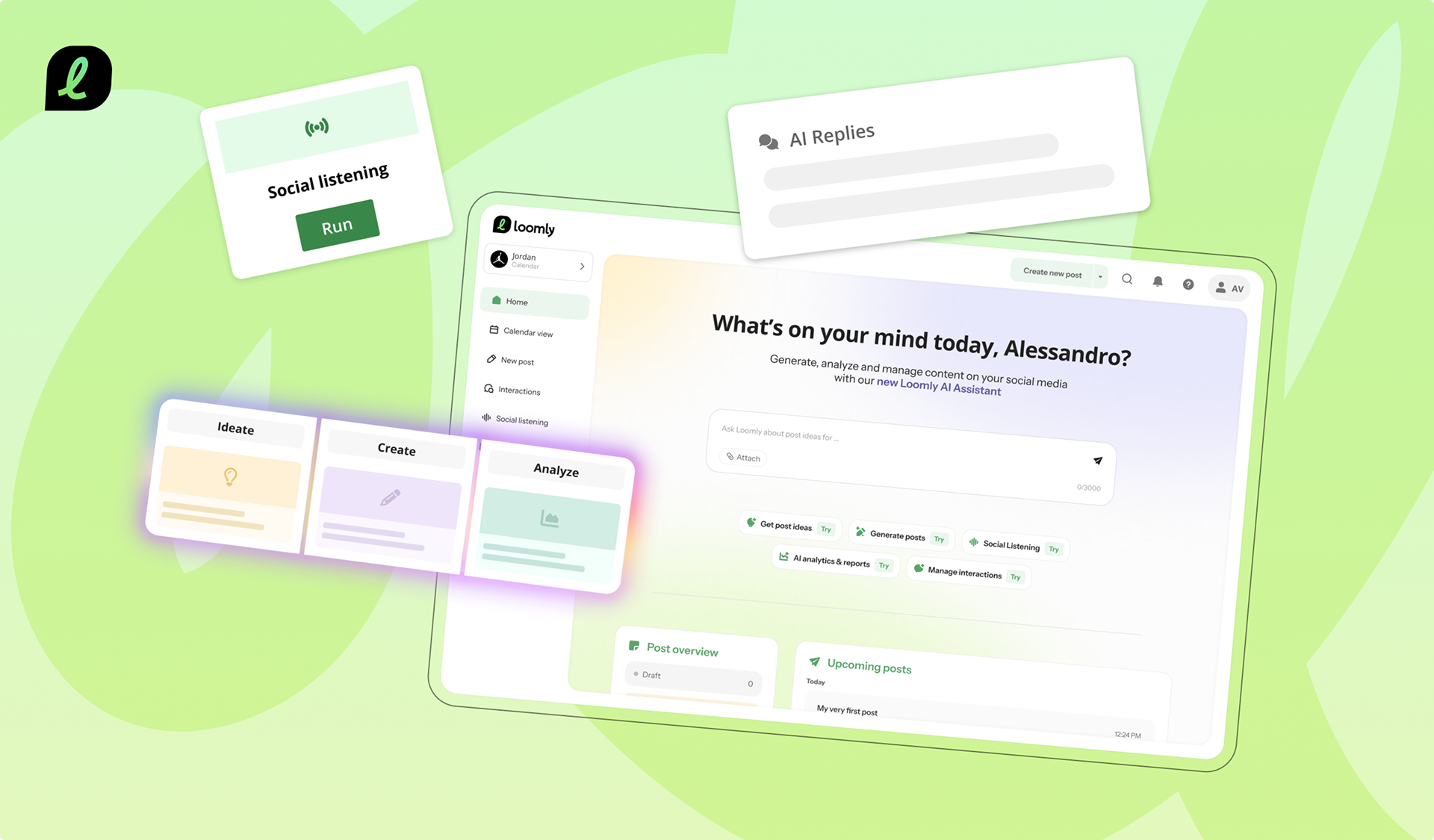
The opportunity was to consolidate the entire content workflow inside a single AI-native product, layering AI across the content lifecycle: idea generation, post creation, social listening, AI analytics, manage DMs and comments, and an ubiquitous AI assistant.
I joined as the only product designer and, given the exploratory nature of the project, also took on partial project management responsibilities.
The project ran on a agile approach and compressed timeline: the first version shipped in ~1 month from kickoff.
Within the first iteration, user research found its place, and I ran 6 usability sessions and interviews with target users. In addition, I shipped a lightweight in-product survey to capture early sentiment after launch and gather ongoing feedback. The research surfaced that the calendar remains the mental backbone of social media work, and that users see AI as a workload reducer and supporting assistant rather than an autonomous creator.
I owned the end-to-end design of the new experience, including the navigation, dashboard, and the AI Assistant behavior across side panel and full screen. Among the main app features, a new look and framework has been given to the onboarding flow, accompanied by the highly awaited Social Listening feature; other sections are the revamped Interactions (DMs and comments manager) with AI-drafted replies, and a new Ideas Board with AI auto-fill. Also, I worked on the new credit-based monetization system with a full-set of paywalls across plans and usage thresholds.
In general the product received a soft rebrand, which peaked in the redesign of the homepage and pricing page of the marketing website. The pivot also extended beyond the app: I contributed to the communication and graphic strategy for the marketing campaign on the London and Glasgow Tube, and backed up media designers in creating the new logo.
Other minor early-phase initiatives included the mobile app revamp and a new link-in-bio feature, where Lovable prototypes replaced Figma specs for pragmatism.
To keep the impact and efficiency high, I adopted an AI workflow that let me work beyond the Figma files, carrying out frontend tasks to refine UI elements and interactions. As of April 2026, I'm exploring an AI automation that bilaterally manages, matches, and refreshes the design system on both Figma and frontend at token and component levels. In general, tools I use include Cursor, Claude (Code, Co-work, and Design), Figma MCPs, and Lovable.
The MVP launched in February 2026, first on new users through A/B testing, then progressively extended to repackaged users and by March on the whole user base. Early signals are promising: at par on monetization, with clear product-side improvements on interactions, analytics, and social listening. Evaluation is still in progress, but the pivot has already redefined Loomly from a scheduling tool to an AI-native content platform.